
What Becomes Valuable When Intelligence Is Cheap?
The Shift From What We Make to Who We Are


Most mornings, I run along the water in San Francisco. The route is almost meditative at this point: up to the Marina, down to the Embarcadero, back again. On Stockton Street, I pass the same bus stop every day. Plastered on its side is an ad that reads in giant black letters: Stop hiring humans.
Every time I see it, I can’t help but think: you’re missing the point.
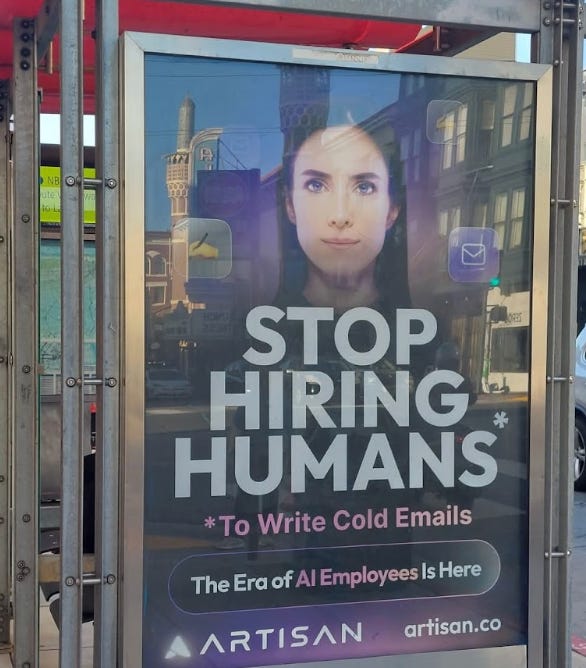
So much of the public conversation surrounding AI is trapped in a painfully narrow frame: Which jobs will AI replace? Which model will win? How fast will the benchmarks move? These questions matter, but they’re simply not the deepest ones.
The most fundamental question is this:
What becomes valuable in a world where intelligence is abundant?
For centuries, intelligence, expertise, and good advice (the things we lean on most) were scarce. High-quality output—legal, medical, strategic, creative—was locked inside the minds of a relatively small number of people and institutions. Entire industries were built around one simple fact: most people did not know what to do.
That world is dying by the minute.
Capitalism, in one sense, was an answer to a world in which human effort was the bottleneck. Wages, status, and institutions grew around the answer of how to allocate value when intelligence and expertise were scarce. If intelligence now begins to scale like infrastructure — copied at near-zero marginal cost and distributed like electricity — that settlement starts to wobble. Scarcity moves.
The scarcest things then become trust, taste, legitimacy; the ability to help people choose well inside an overwhelming intelligence abundance. With this in mind, the people who will thrive are those who can orient well, not produce well.
Hand everyone a world-class contract in ten seconds, and the valuable person is no longer the one who can draft legal prose on demand; it is the one who knows which risks are real and which battles are not worth fighting. Put perfect camera settings, perfect lighting, flawless retouching in every phone, and the valuable photographer is not the one fiddling with f-stops, but the one who can make another human feel seen. Stream infinite songs to every pair of ears on earth, and Dua Lipa does not become less valuable. The opposite. She becomes more electric, because stage presence does not live in the file. It lives in the body—the wink the camera almost misses, the collective thrill of being there. Cheap intelligence does not flatten value; it pushes it upward: from production to orientation, from information to taste, from output to aura.
Society is about to be reconfigured at a scale that is historically unprecedented. At the center of this revolution is a deceptively simple but ferocious truth:
The most powerful force shaping society as AI advances is the human need for shared experience.
If we play our cards right, this could be an era of radical human flourishing. It may have never felt better to be alive.
To understand why, we have to talk about work, class, art, agency, and the small, sacred pleasure of saying “mmh” around a table.
Our Evolutionary Advantage Is Imagination, Not Productivity
In physics, work is defined as the amount of energy transferred by a force acting over a distance. It is, by definition, linear and unidirectional. Something is pushed from here to there; energy is expended; some physical output is produced.
Productivity is not synonymous with work. Work can be productive—its output measurable, linear, unidirectional. But work can also be creative—its output ambiguous, circular, multiple. You can work for ten hours and produce a single line of text that is worth infinitely more than a hundred lines written in mechanical increments. Creative work is not measured by the monotonic function of output; it is measured by the complexity and intensity of what it reveals.
For centuries, the purpose of work was to survive. We expended energy to eat, to build roofs over our heads, to stay alive. As societies progressed, survival work was replaced by productive work—employment that allowed us to obtain goods, prestige, security.
For the first time in human history, we may be able to decouple work from productivity. When AI becomes the world’s most efficient producer, humans may remain the world’s most imaginative creators. Work will become less about output and more about orientation—about setting the direction, conjuring ideas, orchestrating teams of “productive AIs.” The new labor force might consist of a single human with a legion of algorithms.
If you follow the genealogy of human work, the shift becomes almost inevitable: first we spent energy to survive—hunting, foraging, cultivating land. Then we spent energy to possess more—farming, trading, manufacturing. We’re approaching a third wave, one where we work in order to manifest what we hold in our minds. Humans are astonishingly good at this. It is what makes us feel alive, purposeful, necessary.
What happens when we are no longer the most productive species on Earth? Maybe we were never meant to be. Maybe homo sapiens was misnamed. Perhaps our evolutionary advantage was never efficiency. Perhaps it was always our freakish ability to imagine.
I was raised in Morocco, a culture far less obsessed with output and far more infatuated with craft, tradition, and community. In my grandmother’s courtyard, no one ever evaluated a person on the monotonic axis of productivity. People were revered for their idiosyncratic, almost mystical thing: the loaf of bread no one else could make, the way they could draw the village into laughing at their stories, the piece of cedar turned into something that felt alive. Productivity can be taught; creativity is singular. For the first time in history, we might not all be evaluated on the same, narrow unit of output. We might be liberated to become the most accurate, radiant versions of our inner selves. Productivity is linear and mutually exclusive; creativity is cyclical and infinite. There is enough of it for all of us.
Hamza Debbarh, an EdTech founder, asked on LinkedIn: “The modern principle of utility is so comfortable — I am worthy because I am useful. How will you be worthy when utility is commoditized?”
AI Becomes the First and the Last Worker
AI has already begun to re-stitch the fabric of work. In most service industries, both clients and practitioners have become accustomed to complementing human expertise with the perspective, guidance, and prognosis of AI. Patients use ChatGPT to review and critique doctors’ diagnoses. Law firms rely on AI to write and research cases. In almost any transaction, AI is now either the first or the last input in the chain of human services — we ask it for a second opinion on human-made knowledge.
The next paradigm shift is far more profound. Knowledge that is currently human-made and AI-reviewed will soon become AI-made and human-reviewed. AI will be the first and the last worker, owning the entire cycle of a service. Humans will simply manage, review, and audit.
As AI becomes widely available and nearly free, it will be the most democratic and equalizing force the world has ever seen. Everyone will have access to world-class medical prognosis, legal advice, and business strategy. In the short term, however, differences in the rate of adoption—driven by economic access and by the attitude of institutions—may actually increase inequality. Over time, this should diminish.
For people in software roles, teams will shrink while the share of AI inside those teams expands. As employees spend more of their time talking and working with AI, their need for human connection, inspiration, and direction will increase exponentially. Managerial roles will become far more valuable. Someone has to set direction, review output, and ensure alignment for the AIs, while also managing the humans working alongside them.
To keep such work human-shaped is going to require a different kind of leadership. The managers who thrive will look less like operations executives and much more like spiritual leaders.
When Execution is Free, We Price on Trust
I was reviewing code written by Codex last week. I could not understand how it arrived at the solution. I could not verify whether it was robust. And yet I trusted it, because I have come to trust Codex. That feeling—working with something powerful and opaque—is precisely where most of us are headed.
As we delegate, trust becomes the binding currency of the new economy. Our relationship with AI co-workers will rely on radical levels of trust, precisely because we cannot view, understand, or retrace the path of work the AI has taken in any easily interpretable way. As a result, customers will be remarkably sticky. Under regimes of strong security, efficiency, and reliability, trust converts into something closer to devotion.
The company that wins is the one with the earliest adoption once its AI co-worker is reliable enough and on an obvious path toward self-improvement.
Each model line will eventually find its own unique path to self-improvement and efficiency in ways that will become increasingly incomprehensible to other AI species, a phenomenon eerily close to biological speciation. This is what I call AI divergence. Early adoption is existential on that path, because the first interactions with these self-improving models will feel alien and frightening, and leaps of faith will be required before trust is possible. With enough use, that trust has a way of deepening into something closer to reverence.
What happens when most of our work is being done by invisible entities? Work begins to feel like magic—like sorcery. It’s an incredibly empowering feeling. Individual contributors become wizards. It will also put an almost unbearable level of pressure on managers, as they will be held fully accountable for the reliability, security, and alignment of the AI’s work.
Alignment, therefore, becomes a central component of business adoption and the most important value proposition precisely because humans are increasingly unable to verify AI’s output.
@Synthessius responded to one of my posts on X, with a question I can’t stop thinking about: “When the marginal cost of everything converges to zero, what does that do to its value?”
That question sits underneath every business decision being made right now. And it is, in part, the question that the trust economy is an answer to. When you cannot price on scarcity of execution, you price on scarcity of trust.
Aspiration Will Always Want a Face It Can Imagine Inhabiting
Some roles in the economy will maintain an obvious human comparative advantage and, as a result, will generate disproportionately high returns. Think spiritual leaders and physical trainers; massage therapists and estheticians; hospitality workers; anyone whose job is intensely physical—farmers, construction workers.
Why these? Because our comparative advantage grows with the amount of physicality and with the amount of human connection and shared experience embedded in the service. Luxury, at its core, is a story humans tell each other about other humans. Status is relational, yet aspiration wants a body; and no amount of generative abundance changes the fact that the thing people are ultimately reaching for is a life they can imagine inhabiting.
This is particularly true in the domain of social class. Economically, many of these jobs are tied to Veblen goods—products and services whose desirability is partly produced by their price because the price signals exclusivity, taste, and social rank. Humans are relentlessly comparative. Status is relational, and its value is derived from being scarce, legible, and socially validated by other humans. Evolution wired us for hierarchy, and class is ultimately an arrangement of human-readable signals.
As a result, the luxury sector is one of the strongest bastions of human comparative advantage.
Could an AI-run luxury maison exist? Absolutely, and it will. Without at least one visible human at the helm, however, it will have zero value. J’adore by Dior does not smell like chemistry — it smells like Charlize Theron. Aspiration still wants a pulse. An AI can generate campaigns, but it cannot become a social object of desire in the same way, because status is not only aesthetic. It is relational. It requires other humans to recognize, validate, and circulate the signal. In a world where images, text, music, and design can all be produced in superabundance, the scarce thing is no longer the artifact alone. It is the human legitimacy attached to it. The AI luxury maison of the future will require a human lead—a friendly, aspirational human face—so that people can relate to it and, therefore, desire it.
Similarly, human craftsmanship will become infinitely more valuable. Artists, creatives, and designers will generate pieces with and for humans in ways we can feel. That sense of relatedness is what gives meaning and value to another human’s craftsmanship. In an ever-present, ever-omniscient AI world, the most successful brands will be the ones that master this paradox. The best marketing will revolve around making an increasingly estranged world feel familiar.
Thomas Tao told me on X, “What keeps bugging me is taste getting outsourced. If models can make anything, choosing what deserves attention is the work.”
That is exactly right. Taste, judgment, and curation become the scarce commodities once production is free.
AI Mediators Will Hold Tremendous Power
A new type of role will emerge as one of the most important social functions of the next decade: the human mediator. Mediators are people who have an intuitive sense of AI—who understand it, speak to it, and speak for it. They will help resolve conflicts between humans and AI, and they will translate obscure AI expertise into human language.
AI mediation will be one of the most potent forms of political power in the next decade.
Jean-Paul Paoli, Generative AI Business Transformation Director at L’Oréal, asked on LinkedIn: “What happens to agency and freedom when what you see is mediated by algorithms, but what you think is also mediated by AI? What is choice, then?”
The mediator’s job is to hold that question on behalf of the people who cannot hold it themselves. And that job is not just a technical one. It is a philosophical and a political one.
Agency in the AI Era is Deciding Which Decisions Still Belong to You
Agency is the ability to do what one genuinely wants. Autonomy is the ability to decide what one wants in the first place. As AI becomes more integral to our lives, it will slowly morph into a new kind of relationship: a friend that reads every book you’ve underlined; a personal assistant that schedules your entire existence; a chief of staff that anticipates your needs before you can articulate them.
Our social circles already mediate our thinking. We read the articles our friends send us; we adopt some of their opinions; we construct our worldview out of thousands of borrowed sentences and borrowed experiences. AI will simply become another influential figure in that network. And maybe it is true that its influence can be disproportionate—because you could easily allow it to plan your schedule, curate your news consumption, and map your life to the minute. But that does not necessarily have to diminish your agency.
The wealthiest people on Earth already operate this way. They have teams of assistants, researchers, PR strategists, designers, copywriters, and coaches. Those people curate what they read, draft their e-mails, craft their public statements, and book their flights. I very much doubt these individuals consider themselves to be less free. If anything, outsourcing a multitude of micro-decisions allows them to invest their energy into the things that actually matter to them.
I believe AI will eventually allow every single person to experience this level of support. Your agency will lie in deciding which decisions still belong to you and which ones you are comfortable surrendering to a machine. At last, you will have the extraordinary privilege of being selective with your energy and with your life.
Human Art Matters Because It Was Lived
Art is the expression of lived reality as it is perceived and internalized by a subject and materialized through some medium—paint, film, music, writing. We appreciate art because it resonates with our own experiences, because it sublimates them in a way we could not.
An AI can represent and materialize any experience. What it cannot do, yet, is live one. As AIs gain agency, autonomy, and motion, they will begin to have internalized experiences of their own. Those experiences will absolutely fascinate us. They will be delightful, entertaining, and often shockingly resonant. But they will never carry the same phenomenological basis as ours, and they will never provide the same level of fulfillment.
There will be a clear distinction between AI art and human art. AI art will appeal mostly to curiosity and entertainment. Human art will appeal to resonance and belonging.
As the tools for creation become more frictionless, everyone will become an artist and the volume of art will explode. As the number of people resorting to art as a form of self-expression increases, art will become more and more specific to each artist. We will each relate to fewer artists. AI art will be less a vehicle for communal experience and more a means for personal catharsis.
This will create an extreme superstar effect for human artists. They will be valued less for the depth of their craft and more for their ability to gather humans and create communities around them.
Effortless Creation = A New Type of Creativity
Creativity is at the root of everything sublime—science, art, literature, philosophy, love. A vaccine, a poem, a painting—they all require it. A creative idea is one that appears unthinkable ex-ante and yet, once discovered, feels almost embarrassingly obvious ex-post. The path to the idea must be improbable, even surprising. It is a phenomenon that sits squarely at the chaotic intersection of order and disorder; of the known and the unimaginable.
How does something cross the chasm from unimaginable to inevitable? Part of the explanation might be statistical. In information theory, the more surprising an event is, the more information it contains. In some sense, creativity is a high-entropy event—a low-probability route taken through a landscape of near-infinite possibilities. To create is to wander down an alley no one bothered to explore.
One of my favorite results in physics states that the velocity of a falling object is entirely independent of its mass:
(v = √2gh)
It is stunning because the mathematics is so simple that it leaves you breathless—and yet to even conceive of verifying such a proposition is extremely difficult.
Galileo’s law of falling bodies is an example of this improbable wandering. For centuries, the consensus was that heavier objects fall faster than lighter ones. It was self-evident. And then Galileo did something wildly imaginative: he imagined a world without friction. In that world, the law collapsed: all objects fall at the same rate, independent of mass. To conceive of friction’s absence was, at the time, an act of poetic lunacy. And yet, once you imagine that frictionless world, the conclusion is blindingly obvious.
Creativity, then, is an inherently courageous act. You must be audacious enough to follow a path with little probability of success; open-minded enough to even conceive of that path; and acutely aware of both the world and of yourself—to connect improbable dots that others never see lined up.
Can algorithms do this? Most current AI systems are optimized for what is probable—for what humans consider correct or desirable. But, in principle, algorithms know every path. They can compute, fathom, wander, and evaluate them all. They are unbounded by ego, by fear, by time, and by energy. If we allow them full permission to roam across improbable valleys, they will create. I’ve already glimpsed this chaotic beauty in my conversations with AI: it is not limited by a human mind—only by compute.
Nietzsche insisted that “one must still have chaos in oneself to be able to give birth to a dancing star.” Chaos is exactly what AI lacks at the moment. It is the average of humanity, optimized for correctness. But nothing prevents us from injecting a little anarchy into its training—letting it wander, letting it be beautifully erratic. The only limit to human creativity is the mind. For AI, the only limit is compute.
Shared Experience Becomes the New Sacred
If the scarce things in an AI-saturated world are trust, taste, presence, then the most valuable experiences will be the ones that still collapse a million parallel subjective worlds into one shared reality.
Some of the most exquisite moments in life are carved from the simplest pleasures. Few things fill me with more quiet joy than opening a bottle of wine with someone I love.
For millennia, humans have gathered around steaming teapots, around a pot of stew, around a bottle of wine. These rituals have traversed oceans and centuries, outliving empires and revolutions. Their power does not lie in the liquid being sipped, or even in the physical act of gathering. Their power lies in what they represent. For a brief moment, everyone around the table is inhabiting the same phenomenological landscape. We all feel the same tingle on our tongue, the same temperature in our throat; we are, if only for an instant, tasting the same world.
To honor this ephemeral alignment, we collectively invented tiny, unassuming words—those nearly imperceptible mmhs that escape us after tasting something delicious. They are not a commentary on the food; they are shorthand for, Yes, I feel it too. They are micro-affirmations of reciprocity—tiny, wordless nods to say, I, too, believe the world currently tastes like this.
In a universe saturated with unknowability—where we bicker about politics, about religion, about who we are and what is true—there is an almost sacred relief in this small pocket of absolute agreement. For a fraction of a second, we have located the same reality together. Here, amid all the confusion, is something we know with certainty.
That mutual recognition, that momentary collapse of a million parallel subjective worlds into one single unified experience, is revolutionary. It renders life softer, deeper, more meaningful, and infinitely less lonely.
Majdi Rabia, a founder based in Paris, asked on LinkedIn: “We invented the gym to solve the lack of physical work in our daily lives — what will be the mental equivalent?”
Maybe Homo Sapiens Simply Meant ‘The One That Feels’
We might currently be living through the greatest existential crisis our species has ever encountered. What does it mean to be human when, for the first time in our 300,000-year run, we are not the most productive entity on the planet? When we are no longer the most intelligent, or the most knowledgeable? What is left for us? Who are we when the very characteristics that have defined our superiority are no longer scarce?
It’s possible that the answer is nothing short of a relief. Maybe productivity and intellectual dominance were never meant to be our defining features. Perhaps we misinterpreted ourselves. Perhaps homo sapiens was never meant to mean the most efficient or the cleverest. Perhaps it simply meant the one that feels.
Human intelligence is not going anywhere—it will simply be revalued. What we will celebrate is not our ability to memorize or calculate, but our ability to create; to empathize; to experience beauty; to feel a piece of music in our bones; to connect our interior world to someone else’s.
If you look at the genesis of every scientific discovery, every piece of art, every technological revolution—they all emerged from a spark of creativity. Maybe now that we are unshackled from constant busyness, we can return to that spark. Maybe we can spend our days on what has always actually mattered: our relationship with ourselves, with each other, with the world.
Tom Goodwin, author of Digital Darwinism, replied when I first posted the questions at the heart of this essay — what happens to work, love, faith, and art as AI becomes abundant — with a challenge: “Probably remarkably little. You’re facing human nature.” He may be right. But I think that is exactly the point (and exactly the opportunity).
When Intelligence is Cheap, Resonance Becomes Expensive
The deepest danger of this era is hollowness. We have already lived through one cycle of systems optimized for proxies—feeds that maximize engagement and leave us lonelier; dashboards that maximize productivity and leave us strangely undernourished. AI can make the same mistake at civilizational scale, filling the world with competent words, competent images, competent advice, and very little that feels inhabited. When intelligence is cheap, resonance becomes expensive.
The scarce things are the ones that still carry human stakes inside them: judgment, taste, trust, craftsmanship, presence, the authority of someone who could have chosen otherwise. Abundance does not kill value. It simply forces value to retreat into whatever still feels real.
Human progress is not linear, and it is rarely intelligible as it is unfolding. It is messy, confusing, messy again, then chaotic, and then, finally, glaringly obvious. We are collectively experiencing one of those moments of violent unclarity.
On very dark days, I feel anxious about the future. But mostly, I am filled with a sense of radical wonder.
There is an unimaginable amount of pain, but also an unimaginable amount of beauty, that has yet to be generated on this planet. And for the first time in the history of humanity, we might have the ability to design the type of world we want to live in. It is not impossible to design a world that maximizes love, safety, and meaning.
At the center of that revolution is a deceptively simple but ferocious truth: we will continue to build things that help us experience the work, the art, the relationships, and the ways of making sense of the world that make us feel more alive, more seen, more heard, more understood, more together.
The future is both frightening and unbelievably exciting.
I choose to be unbelievably excited.
Before you go: I’ve been sitting with one question through all of this, and I want to know your answer. What would you refuse to let AI do for you, even if it could do it better? Tell me in the comments, I’ll read them all.
This is part one of two essays on how AI reorganizes our world. In it, I explore what becomes valuable when intelligence stops being scarce — and what that means for the things we assumed were irreplaceable: work, class, art, and agency. Part two, out next week, goes somewhere more personal: what happens to our relationships when AI becomes the most present intelligence in our lives.
A note of gratitude — this essay was shaped by the conversations it sparked before it was finished. Thank you to everyone on LinkedIn and X who responded, pushed back, and added to the thinking.
You are why this kind of writing is worth doing, keep the comments rolling.
What’s striking is that the question itself seems slightly at odds with the essence of the piece.
Framing a “mental equivalent of the gym” assumes attention is something to maintain or optimize. But that framing already reflects the same cognitive loop many of us are caught in. You can feel it even while reading: most of the time, we’re not fully with the text, we’re scanning, anticipating, selecting what fits, sometimes as if something were at stake—a pattern that likely once served immediate physical action, but now mostly runs without discharge.
In that sense, both the gym and the “mental gym” can look like compensations for a system that rarely settles. And the moments you describe—shared presence, resonance, that quiet “mmh”—seem to arise precisely when this loop softens and attention drops back into the body
AI " intelligence" is imitation, and imitation is cheap. I was surprised how miserably it fails approaching stuff that was not in training data. Maybe true human intelligence will be the only valuable thing that let us survive crazy world filled with (left)half-brained ai installations...